A South Sudan student visa is a permit issued by the Directorate of Civil Registry, Nationality, Passports and Immigration that allows foreign nationals to study at accredited institutions in South Sudan. The application costs $100-$150 and takes 2-4 weeks to process. You apply through the eServices portal at eservices.gov.ss or at a South Sudanese embassy.
South Sudan, the world’s youngest country, is investing in its education system with several universities and technical institutions welcoming international students. If you plan to study in South Sudan, you must obtain a student visa before enrolling. The process involves securing admission from a recognized institution, gathering the required documents, and submitting your application through the official immigration channels.
This guide covers everything you need to know about the South Sudan student visa: who needs one, the requirements, step-by-step application process, fees, processing times, and what to expect after arrival.
Who Needs a Student Visa for South Sudan?
Every foreign national who intends to study at a South Sudanese educational institution needs a student visa, regardless of the duration of their program. This includes university students, vocational trainees, research scholars, and exchange program participants.
The South Sudan student visa requirement applies to:
- University students enrolled in undergraduate or postgraduate programs
- Vocational and technical students attending training institutions
- Research scholars conducting academic research in South Sudan
- Exchange students participating in bilateral education agreements
- Language students enrolled in English or local language programs
If you are only visiting a South Sudanese university for a short conference or academic event, a business visa or tourist visa may be sufficient. However, any form of enrolled study or academic research requires a valid student visa.
South Sudan Student Visa Requirements
To apply for a South Sudan student visa, you must provide a valid passport, an acceptance letter from a recognized institution, proof of financial means, a medical certificate, and passport-sized photographs. All documents must be in English or accompanied by certified translations.
Required Documents
Here is the complete list of documents needed for a South Sudan student visa application:
- Valid passport with at least six months of validity remaining and at least two blank pages
- Acceptance letter from a South Sudanese educational institution accredited by the Ministry of General Education and Instruction
- Completed visa application form available through the eServices portal or at a South Sudanese embassy
- Two recent passport-sized photographs (35mm x 45mm, white background)
- Proof of financial means showing you can cover tuition fees, living expenses, and return travel. Bank statements from the last three months are typically required
- Medical certificate confirming good health and fitness to study, issued within the last six months
- Yellow fever vaccination certificate if arriving from a country with risk of yellow fever transmission
- Proof of accommodation in South Sudan, such as a university hostel confirmation letter or rental agreement
- Police clearance certificate from your country of residence, issued within the last six months
- Academic transcripts and certificates from previous educational institutions
Passport Requirements
Your passport must meet the following criteria:
- Valid for at least six months from your intended date of entry
- At least two blank pages for visa stamps
- In good physical condition (no torn pages, water damage, or faded text)
How to Apply for a South Sudan Student Visa
The South Sudan student visa application is a multi-step process that begins with securing admission from an accredited institution. You can apply online through the eServices portal at eservices.gov.ss or in person at a South Sudanese embassy or consulate.
Step-by-Step Application Process
Step 1: Secure Admission from a Recognized Institution
Before applying for a student visa, you must receive an official acceptance letter from a South Sudanese educational institution recognized by the Ministry of General Education and Instruction. Contact the institution directly to learn about their admission requirements, which typically include academic transcripts, a statement of purpose, and language proficiency proof.
Step 2: Gather Required Documents
Collect all the documents listed in the requirements section above. Ensure that all documents are in English or accompanied by certified translations. Documents from your home country may need to be apostilled or authenticated by the relevant authorities.
Step 3: Complete the Visa Application Form
Visit the South Sudan eServices portal at eservices.gov.ss and create an account. Navigate to the Directorate of Civil Registry, Nationality, Passports and Immigration section, and select the student visa application. Fill in all required fields accurately, including personal details, educational background in South Sudan, and intended duration of stay.
Step 4: Upload Supporting Documents
Scan and upload all required documents in the specified formats (typically PDF or JPEG). Ensure all scans are clear, legible, and show the complete document. Blurry or partial uploads may result in application delays or rejection.
Step 5: Pay the Visa Fee
Pay the student visa application fee online using the available payment methods on the eServices portal. Accepted payment methods typically include mobile money, debit cards, credit cards, and online banking from local banks. Keep the payment receipt for your records.
Step 6: Submit Your Application
Review all entries and uploaded documents before final submission. Once submitted, you will receive a confirmation email with a reference number. Use this reference number to track your application status through the eServices portal.
Step 7: Attend an Interview (If Required)
Some applicants may be invited for an interview at the nearest South Sudanese embassy or consulate. During the interview, you may be asked about your study plans, financial situation, and ties to your home country. Bring original copies of all submitted documents.
Step 8: Receive Your Visa
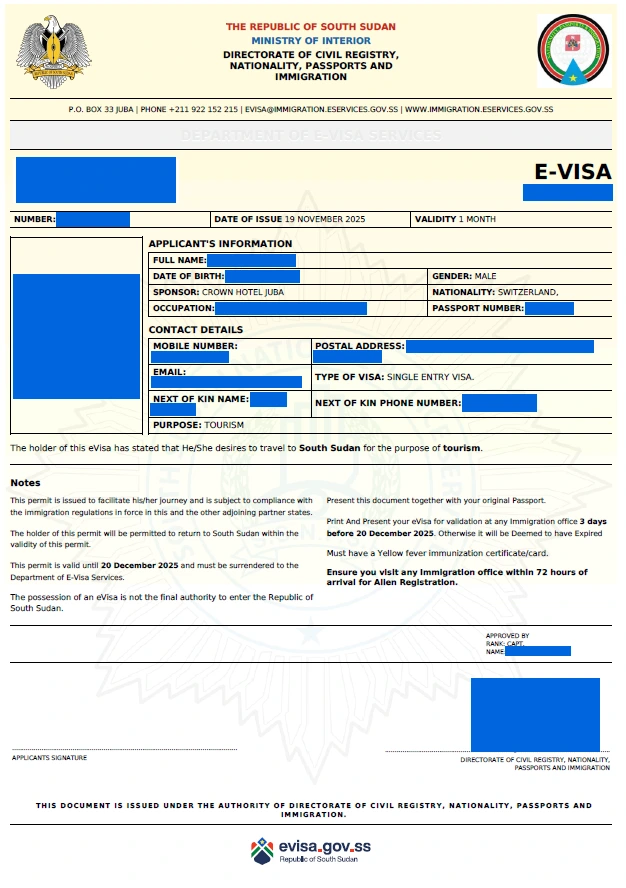
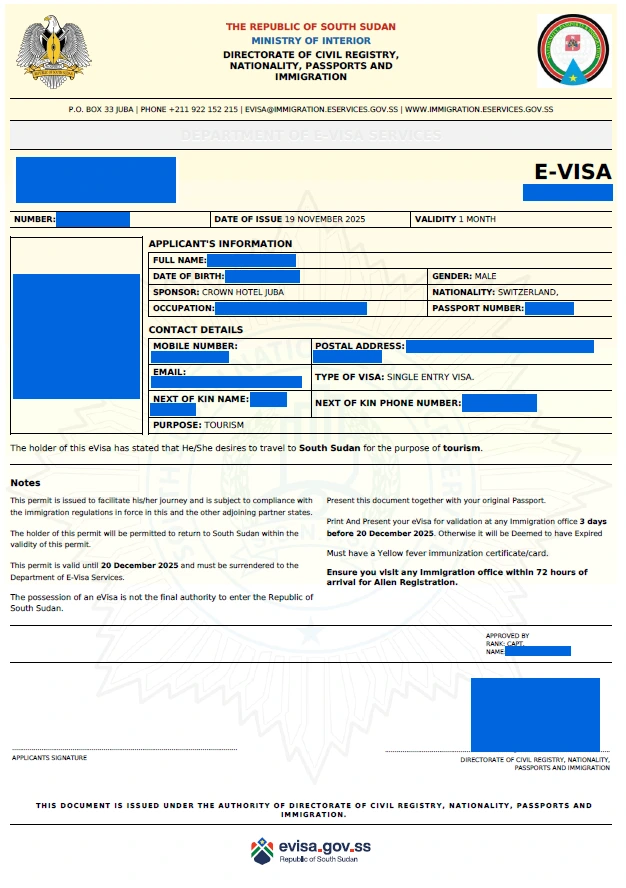
Once approved, your student visa will be issued. If applied online, you may receive an electronic visa (e-Visa) via email. Print a hard copy and carry it with your passport when traveling to South Sudan.
South Sudan Student Visa Fees
The South Sudan student visa costs $100 for a single-entry visa valid for up to six months, or $150 for a multiple-entry visa valid for one year. Fees are paid online through the eServices portal and are non-refundable.
| Visa Type | Fee | Validity | Entry Type |
|---|---|---|---|
| Short-Term Student Visa | $100 | Up to 6 months | Single entry |
| Long-Term Student Visa | $150 | Up to 1 year | Multiple entry |
| Student Visa Extension | $50 | Per additional 6 months | N/A |
Processing fees are separate from tuition fees charged by the educational institution. The visa fee is non-refundable even if your application is denied. Always verify the current fee schedule on the official eServices portal, as fees may be updated periodically.
South Sudan Student Visa Processing Time
Standard processing for a South Sudan student visa takes 2 to 4 weeks from the date of submission. Applications submitted during peak enrollment periods (August to October and January to February) may take longer.
The processing timeline typically follows this pattern:
- Application review: 3-5 business days
- Document verification: 5-7 business days
- Background check: 3-5 business days
- Decision and issuance: 2-3 business days
To avoid delays, apply at least six to eight weeks before your program start date. Submitting an incomplete application or providing unclear documents is the most common cause of processing delays.
For current processing times, check the status of your application through the eServices portal or read our detailed guide on South Sudan visa processing times.
Universities and Educational Institutions in South Sudan
South Sudan has several universities and higher education institutions that accept international students. The main institutions are located in Juba, the capital city, and include both public and private universities.
Major Universities
- University of Juba — The oldest and largest public university, offering programs in arts, sciences, engineering, medicine, and social sciences
- University of Upper Nile — A public university with campuses in Malakal and Renk, focusing on education, agriculture, and health sciences
- University of Bahr El Ghazal — Located in Wau, offering programs in education, agriculture, and social studies
- Dr. John Garang Memorial University of Science and Technology — A public institution in Bor focusing on science and technology education
- Catholic University of South Sudan — A private university in Juba offering programs in business, education, and social sciences
- Yei University — A private institution in Yei offering various undergraduate programs
English is the primary language of instruction at all South Sudanese universities. International students whose first language is not English may need to provide proof of English language proficiency.
Living in South Sudan as a Student
Students in South Sudan should be aware that the cost of living in Juba is relatively high compared to other East African capitals. Monthly living expenses range from $500 to $1,200, depending on accommodation, food, and transportation choices.
Accommodation
- University hostels are available at some institutions and cost between $50 and $150 per month
- Private rentals in Juba range from $200 to $600 per month for basic apartments
- Shared housing with other students can reduce costs to $100 to $300 per month
Cost of Living (Monthly Estimates in Juba)
| Expense | Estimated Cost (USD) |
|---|---|
| Accommodation | $200 – $600 |
| Food and groceries | $150 – $300 |
| Transportation | $50 – $100 |
| Utilities | $30 – $80 |
| Books and supplies | $30 – $50 |
| Personal expenses | $50 – $100 |
Safety and Health
- Register with your country’s embassy upon arrival in Juba
- Ensure you have valid travel insurance that covers medical evacuation
- Keep a copy of your passport and student visa at all times
- Carry your yellow fever vaccination certificate
Extending Your Student Visa
If your study program extends beyond the validity of your student visa, you must apply for a visa extension before it expires. Extensions cost $50 per additional six-month period and must be applied for through the Directorate of Civil Registry, Nationality, Passports and Immigration.
To extend your student visa:
- Visit the immigration office in Juba or use the eServices portal
- Provide a letter from your institution confirming continued enrollment
- Submit your current passport with the valid student visa
- Pay the extension fee of $50
- Provide updated proof of financial means
Apply for an extension at least 30 days before your current visa expires. Overstaying your visa can result in fines, detention, and future visa application difficulties. For more details, read our guide on South Sudan visa extensions.
Work Rights for Students in South Sudan
Student visa holders in South Sudan are generally not permitted to work during their studies. If you wish to work in South Sudan, you must apply for a separate work visa through the Ministry of Labour. Limited part-time work may be permitted in exceptional cases with written approval from both your institution and the immigration authorities.
If you are offered employment during or after your studies, review our South Sudan work visa guide for information on obtaining the proper work authorization.
Important Tips for International Students
- Apply early: Start the visa process at least 6-8 weeks before your program begins
- Verify accreditation: Ensure your chosen institution is recognized by the Ministry of General Education and Instruction
- Keep copies: Maintain digital and physical copies of all documents, including your visa, passport, acceptance letter, and financial statements
- Health precautions: Consult a travel health clinic about recommended vaccinations and medications for South Sudan
- Currency: The official currency is the South Sudanese Pound (SSP), but US dollars are widely accepted
- Language: English is the official language and medium of instruction at universities
- Insurance: Arrange comprehensive travel and health insurance before departure
Frequently Asked Questions
Can I apply for a South Sudan student visa online?
Yes, you can apply through the official eServices portal at eservices.gov.ss. Create an account, navigate to the immigration section, and follow the student visa application process. You can also apply in person at a South Sudanese embassy or consulate.
How much does a South Sudan student visa cost?
A short-term student visa (up to 6 months) costs $100, while a long-term student visa (up to 1 year) costs $150. Extensions cost $50 per additional six-month period. Fees are non-refundable.
How long does it take to get a South Sudan student visa?
Standard processing takes 2 to 4 weeks. During peak enrollment periods, processing may take longer. Apply at least 6 to 8 weeks before your program start date to avoid delays.
Can I work while studying in South Sudan?
Student visa holders are generally not permitted to work. Limited part-time work may be allowed with written approval from your institution and immigration authorities. For employment, you need a separate work visa.
What happens if my student visa expires?
Overstaying your visa is a serious offense in South Sudan. You may face fines, detention, and a ban on future visa applications. Always apply for a visa extension before your current visa expires.
Do I need a yellow fever vaccination to study in South Sudan?
Yes, a valid yellow fever vaccination certificate is required if you are arriving from a country with a risk of yellow fever transmission. Even if not required, vaccination is strongly recommended for all travelers to South Sudan.
Is English the language of instruction at South Sudanese universities?
Yes, English is the official language and the primary medium of instruction at all levels of education in South Sudan, including universities and technical institutions.
Can I bring my family with me on a student visa?
A student visa does not automatically grant dependent visas for family members. Spouses or children would need to apply for their own visas, such as a tourist visa or a dependent visa through the immigration authorities.