
South Sudan offers visa on arrival to citizens of Burundi and Rwanda, while most other nationalities must apply for an e-Visa online before traveling. The visa on arrival (VoA) is a limited program — only two countries qualify for regular VoA, though diplomatic and official passport holders from any nation can also obtain one at the border.
What Is the South Sudan Visa on Arrival?
The South Sudan visa on arrival is a travel permit issued at the port of entry to eligible visitors who have not obtained a visa in advance. Unlike the e-Visa system that requires online pre-approval, the VoA allows qualifying travelers to complete immigration formalities when they land at Juba International Airport or arrive at one of the country’s land border crossings.
The VoA is managed by the Directorate of Civil Registry, Nationality, Passports and Immigration under the Ministry of Interior. Officers at the port of entry verify eligibility, collect the fee (if applicable), and stamp the passport on the spot.
Who Is Eligible for Visa on Arrival in South Sudan?
South Sudan’s VoA program is narrow compared to many other African nations. According to Timatic and the official evisa.gov.ss portal, the following categories of travelers can obtain a visa on arrival:
Regular Passport Holders
Only citizens of these two countries qualify for a standard visa on arrival:
| Country | Visa Type | Fee |
|---|---|---|
| Burundi | Visa on Arrival | $100 (single entry) |
| Rwanda | Visa on Arrival | $100 (single entry) |
Diplomatic and Official Passport Holders
Holders of diplomatic, official, service, and special passports issued by any country can obtain a visa on arrival at no cost. This exemption covers government officials, diplomats, and international organization representatives traveling on official business.
United Nations Personnel
Travelers holding a United Nations identity card copy can receive a visa on arrival, provided they have clearance from the Ministry of Foreign Affairs in South Sudan.
Who Needs an e-Visa Instead?
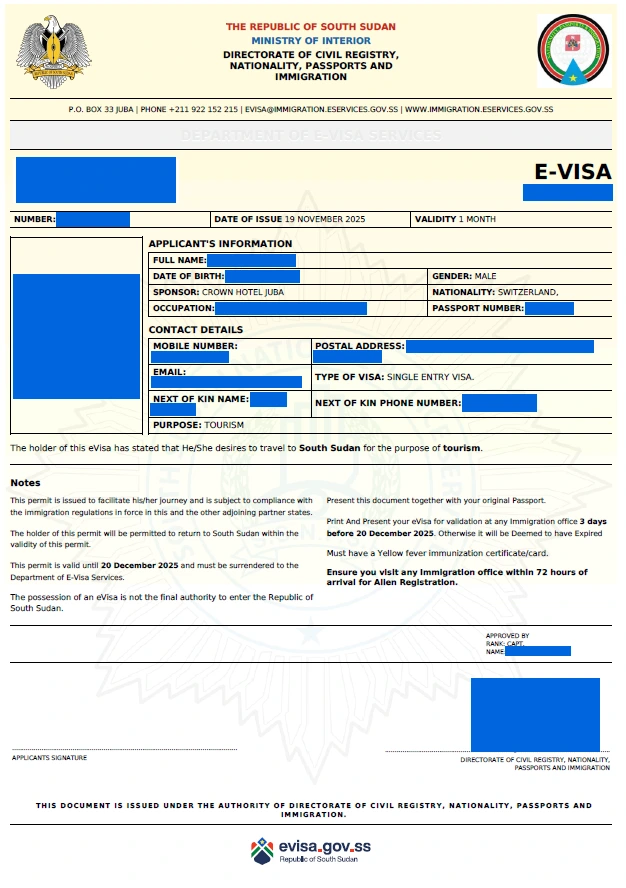
If you are not a citizen of Burundi or Rwanda and do not hold a diplomatic or official passport, you must apply for an e-Visa through the official portal at evisa.gov.ss before your trip. This includes citizens of the United States, United Kingdom, Canada, Australia, India, Nigeria, and all other nationalities not listed above.
Some countries enjoy full visa exemption and do not need either a VoA or an e-Visa. Citizens of Kenya, Tanzania, and Uganda can enter South Sudan without any visa for an indefinite period, thanks to regional agreements within the East African Community (EAC).
South Sudan Visa on Arrival: Fees and Validity
The visa on arrival fee for Burundian and Rwandan citizens is $100 USD for a single-entry visa valid for up to 90 days. This matches the standard e-Visa fee that most travelers pay online.
| Visa Type | Fee | Validity | Entries |
|---|---|---|---|
| Standard VoA | $100 | 90 days | Single |
| Multiple-entry (if available at border) | $120 | 180 days | Multiple |
| Diplomatic/Official | Free | Per assignment | Multiple |
| EAC nationals (Kenya, Tanzania, Uganda) | Free | Indefinite | Unlimited |
Payment at the port of entry is typically accepted in US dollars. It is advisable to carry exact change, as card payment facilities may not be available at all border crossings.
Entry Points for Visa on Arrival
Travelers with a visa on arrival can enter South Sudan through the following ports:
Airport:
– Juba International Airport (JUB) — the main international gateway
Land border crossings:
– Nadapal (border with Kenya)
– Kaya (border with Uganda)
– Nimule (border with Uganda — the busiest land crossing)
– Majok Nyin Thiou (border with Ethiopia)
– Renk (border with Sudan)
Juba International Airport handles the majority of international arrivals. The Nimule border crossing is the most frequently used land entry point, connecting Kampala (Uganda) to Juba by road.
Documents Required at the Port of Arrival
Whether you are entering with a visa on arrival or an e-Visa, you will need to present the following documents at the immigration counter:
- Valid passport with at least 6 blank pages and 6 months validity remaining
- Yellow fever vaccination certificate — mandatory for all travelers
- Return or onward ticket (recommended)
- Proof of accommodation in South Sudan
- Sufficient funds for your stay
- Passport-size photographs (recommended as backup)
The immigration officer will verify your documents, stamp your passport, and grant entry. The process typically takes about 5 minutes if all paperwork is in order.
Visa on Arrival vs. e-Visa: Which Should You Choose?
If you are eligible for a visa on arrival, you may wonder whether to use it or apply for an e-Visa instead. Here is a comparison:
| Factor | Visa on Arrival | e-Visa |
|---|---|---|
| Eligibility | Burundi, Rwanda only | All nationalities (except exempt) |
| Application | At the border | Online before travel |
| Processing time | Immediate | 3-5 business days |
| Fee | $100 | $100 |
| Risk | Low (if eligible) | None — approved before travel |
| Convenience | No pre-application needed | Peace of mind before departure |
For Burundian and Rwandan citizens, both options work. However, applying for the e-Visa in advance is generally recommended because it eliminates uncertainty at the border. If any issue arises with your documents or eligibility, you will know before you board your flight.
Important Tips for Travelers
- Carry cash in USD — ATMs and card machines are extremely limited in South Sudan, especially outside Juba.
- Register with your embassy — The US, UK, and other governments advise their nationals to register travel plans before visiting South Sudan.
- Yellow fever vaccination is non-negotiable. You will be denied entry without a valid certificate.
- 7-day arrival window — If you apply for an e-Visa, you must enter South Sudan within 7 days of your application submission date.
- Health facilities are limited — Medical evacuation to Nairobi or Kampala may be necessary for serious conditions. Ensure you have adequate travel health insurance.
- Rainy season disruptions — From April to November, flights and road travel can be severely affected by weather conditions.
How the South Sudan Visa on Arrival Process Works
The step-by-step process at the port of entry is straightforward:
- Arrive at Juba International Airport or a land border crossing
- Proceed to the immigration/visa on arrival counter
- Present your passport, yellow fever certificate, and supporting documents
- Pay the visa fee in US dollars (if applicable)
- Wait while the officer processes your entry (approximately 5 minutes)
- Receive your passport stamp and enter South Sudan
The process is the same at all entry points, though wait times may vary depending on the number of arriving passengers.
South Sudan Visa on Arrival vs. Other African Countries
South Sudan’s visa on arrival program is one of the most restrictive in East Africa. By comparison, countries like Ethiopia, Kenya, and Rwanda offer visa on arrival or e-Visa options to dozens of nationalities. This limited VoA access reflects South Sudan’s ongoing political situation and security considerations.
For travelers who need to visit South Sudan but do not qualify for VoA, the e-Visa remains the primary pathway. Understanding the full South Sudan eVisa requirements and fee structure will help you prepare a complete application.
FAQs About South Sudan Visa on Arrival
Can I get a visa on arrival in South Sudan if I am not from Burundi or Rwanda?
No. Unless you hold a diplomatic, official, or service passport, you must apply for an e-Visa online before traveling. Citizens of Kenya, Tanzania, and Uganda do not need any visa at all.
How much does the South Sudan visa on arrival cost?
The standard visa on arrival fee is $100 USD for a single-entry visa valid for 90 days. Diplomatic and official passport holders receive visas free of charge.
Can I pay for the visa on arrival with a credit card?
Payment is typically accepted in US dollars cash only. There are no reliable card payment facilities at most ports of entry. Carry exact change in USD bills dated 2009 or later.
How long can I stay with a visa on arrival?
The standard visa on arrival grants a stay of up to 90 days. If you need to stay longer, you can apply for an extension at the Ministry of Interior in Juba.
Is the visa on arrival available at land border crossings?
Yes. Visa on arrival is available at all official entry points, including Juba International Airport and the five land border crossings at Nadapal, Kaya, Nimule, Majok Nyin Thiou, and Renk.
Do I need a yellow fever certificate for South Sudan?
Yes. A valid yellow fever vaccination certificate is mandatory for all travelers entering South Sudan, regardless of your nationality or visa type.
Should I apply for an e-Visa instead of getting a visa on arrival?
Even if you are eligible for a visa on arrival, applying for the e-Visa in advance is recommended. It removes uncertainty and ensures your entry is pre-approved before you travel.